
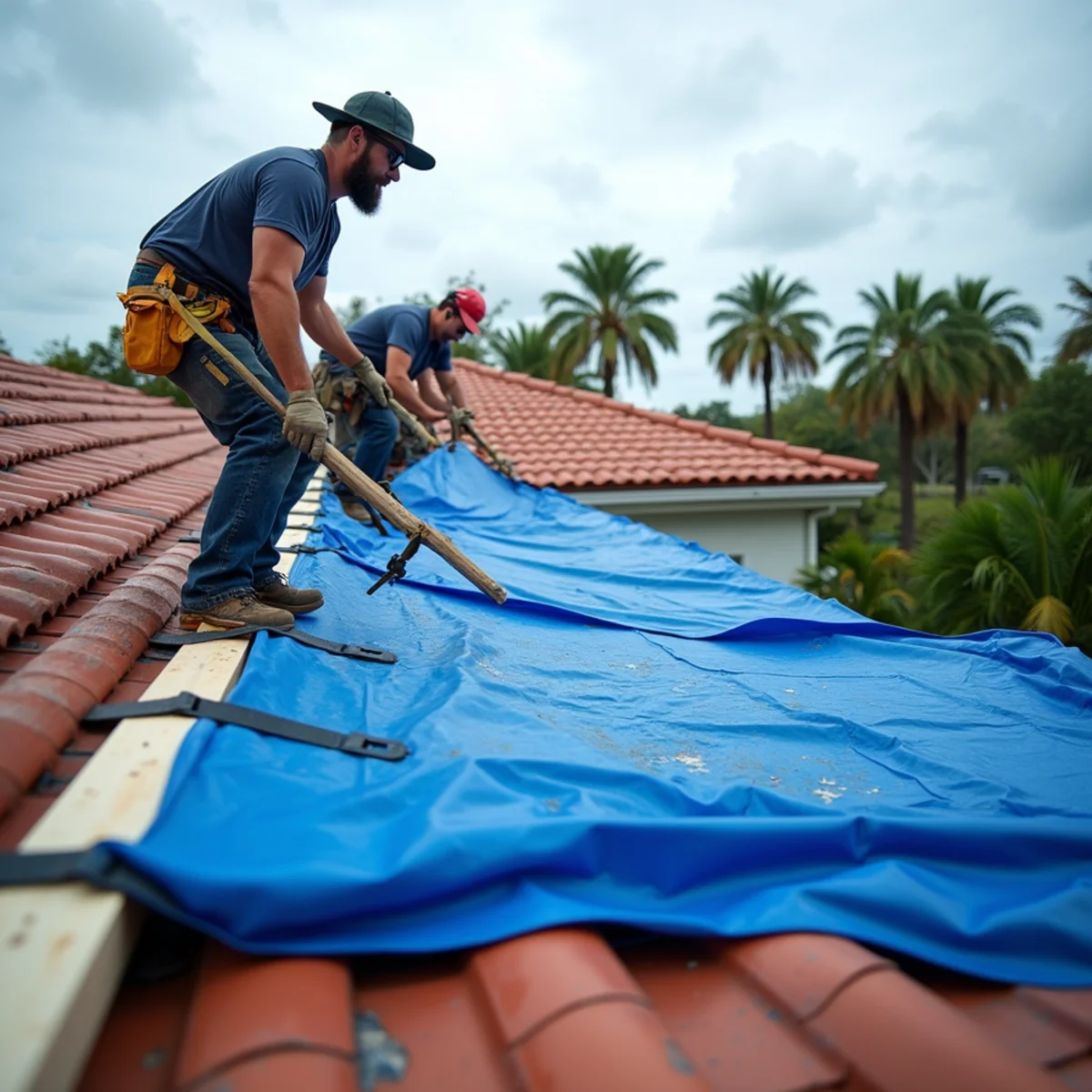
When a storm opens your roof, the tarp that goes over it is the only thing standing between your home and the next rain band. A tarp thrown on and weighted with a few bricks will not survive South Florida wind, and a failed tarp can leave you worse off than none at all. Call (831) 666-1600 and we will install a cover that is anchored to hold: the right size, fastened into sound structure, with edges sealed and water directed off the roof rather than pooling behind it.
Tarping is not only about protecting the inside of your house. Your insurance policy places a duty on you to take reasonable steps to prevent further damage after a covered loss, and a documented, professional tarp is exactly that. We photograph the damage and the completed cover, dated, so you have proof you acted, which our post on the insurance mitigation duty explains in full.
Signs you need roof tarping in Boca Raton
A DIY tarp that will not hold
Tarps held down by weights or nailed only at the corners lift in the first gust and can tear away, leaving the roof exposed again and often causing more damage on the way off.
Water pooling behind the tarp
A cover installed without directing water downhill traps rain against the opening, so the tarp itself becomes a basin that pushes water into the home.
Large or complex openings
A limb through the deck or a peeled section around a chimney or skylight is too big and too irregular for an off-the-shelf tarp and needs proper boarding first.
Fragile or steep tile roofs
Walking a wet, steep tile roof to tarp it safely takes the right equipment and experience so the crew does not crack more tile or get hurt in the process.
Our process
- 1
Assess and board the opening
We evaluate the damage, and where there is a hole in the deck we board it with structural sheathing so the tarp has something solid to seal against.
- 2
Size and position the cover
We run the tarp well past the damage on all sides and up over the ridge where needed, so wind-driven rain cannot get under the uphill edge.
- 3
Fasten into sound structure
The tarp is anchored with furring strips and fasteners into solid framing or decking, not weighted down, so it stays put in wind. Every penetration is placed to shed water.
- 4
Seal edges and direct water
We seal the perimeter and set the tarp to carry water down and off the roof, never trapping it behind the cover where it can back up under the roofing.
- 5
Document and plan the repair
We photograph the finished tarp for your records, then schedule the permanent <a href="/hurricane-roof-damage-repair/">storm damage repair</a> or replacement once conditions allow.
Why a professional tarp beats a DIY cover
It is tempting to buy a tarp from the hardware store and get it up before the next band arrives, and if you can do that safely from a ladder over a small area, it is better than nothing in the short term. The problem is that most DIY tarps fail exactly when they are needed most. Weighted or corner-nailed tarps balloon and tear in wind, and a cover that traps water behind it can drive more water into the house than the original leak. A wet tile roof is also genuinely dangerous to walk.
A professional tarp is engineered to hold. We run it past the damage on every side, anchor it into solid framing with furring strips, seal the edges, and set it so water sheds off the roof. Done right, it buys you weeks of protection while materials are ordered and the claim is worked, instead of hours.
Tarping and your insurance mitigation duty
Nearly every homeowner policy includes a duty to protect the property from further damage after a covered loss. If you do nothing and the interior floods over the following week, the carrier can reduce or deny the part of the claim that resulted from the delay. A prompt, documented tarp is how you meet that duty and protect your claim at the same time.
We photograph the damage before and the tarp after, dated, and provide that record along with a written scope. When you are ready for the permanent fix, our insurance claim support and hurricane damage repair teams pick up from there.
Roof Tarping across Palm Beach & Broward County
When a roof opens up, a fast, well-anchored tarp matters more than anything, and we install them throughout Palm Beach and Broward. We tarp storm-damaged roofs in Highland Beach, Ocean Ridge, and Delray Beach along the Palm Beach coast, and in Hillsboro Beach, Lighthouse Point, and Pompano Beach in Broward, usually the same day you call.
A tarp is emergency mitigation, so it does not carry a product approval, but the permanent repair underneath it does. In Broward's High-Velocity Hurricane Zone the rebuild must use HVHZ-approved, NOA-listed materials; in Palm Beach County it follows Florida Product Approval outside the HVHZ. We install the cover to hold in either county's wind and document it for your claim, then match the permanent scope to the code where you live.
What affects your price
Tarping is priced on the size of the area, the height and pitch of the roof, and whether boarding is needed. On a covered storm claim, emergency tarping is typically reimbursable. We give you the number before we start.
- Area to cover
- A single slope over one room is a small job; a large or multi-section opening needs more material and labor.
- Boarding required
- An actual hole in the deck needs structural sheathing installed under the tarp, which adds material and time.
- Roof height and pitch
- Steep and second-story roofs require more staging, safety setup, and crew to tarp safely.
- Tarp versus shrink-wrap
- Heavy-gauge tarp handles most openings; a heat-shrunk wrap can be warranted for larger or longer-term coverage.
- Storm conditions
- Working during active weather or immediately after a widespread storm affects mobilization and timing.
These are honest planning ranges, not a quote. Your written scope confirms the real price after a free inspection. Call (831) 666-1600.
Why choose Mighty Dog Roofing for roof tarping
- Covers fastened into sound structure so they hold in wind, not weighted down
- Openings in the deck boarded before the tarp goes on
- Water directed off the roof, never trapped behind the tarp
- Dated photos of the damage and the finished cover for your insurance claim
- Crews equipped to tarp steep and fragile tile roofs safely
- A clear path from the temporary cover to the permanent repair